Handicaps
How to Calculate Golf Handicaps for Team Events
Handicaps are what make team golf fair. Without them, the lowest-handicap players dominate every match and higher-handicap players never contribute. Apply them correctly and a 20-handicap can compete head to head with a scratch golfer, every match stays close, and the outcome comes down to who plays their best on the day.
The tricky part is that handicap allocation works differently depending on the format. Match play, best ball, alternate shot, and scramble each have their own rules. This guide breaks down exactly how to calculate and apply handicaps for the team formats you are most likely to use.
Understanding the USGA Handicap System
The USGA World Handicap System gives every golfer a single number called a Handicap Index. It represents your potential ability and is calculated from the best 8 of your last 20 scores, adjusted for the difficulty of the courses you played.
But you do not use your Handicap Index directly during a round. You convert it into a Course Handicap, which accounts for the specific course and tees you are playing that day. The course handicap calculator does this automatically for up to four players at once.
The formula
Course Handicap = Handicap Index × (Slope Rating ÷ 113) + (Course Rating − Par)
For example, a player with a 15.0 Handicap Index playing a course with a Slope Rating of 130 and a Course Rating of 72.5 (Par 72) would get: 15.0 × (130 ÷ 113) + (72.5 − 72) = 17.8, rounded to 18.
The Slope Rating measures how much harder a course is for a bogey golfer compared to a scratch golfer. A standard slope is 113. The higher the slope, the more strokes a higher-handicap player receives. This keeps things fair regardless of the course difficulty.
Once every player has a Course Handicap, you can allocate strokes for whatever format you are playing. That allocation is where things get format-specific. CupTracker follows the USGA Rules of Handicapping and handles this automatically for every supported format.
How to Apply Handicaps in Match Play
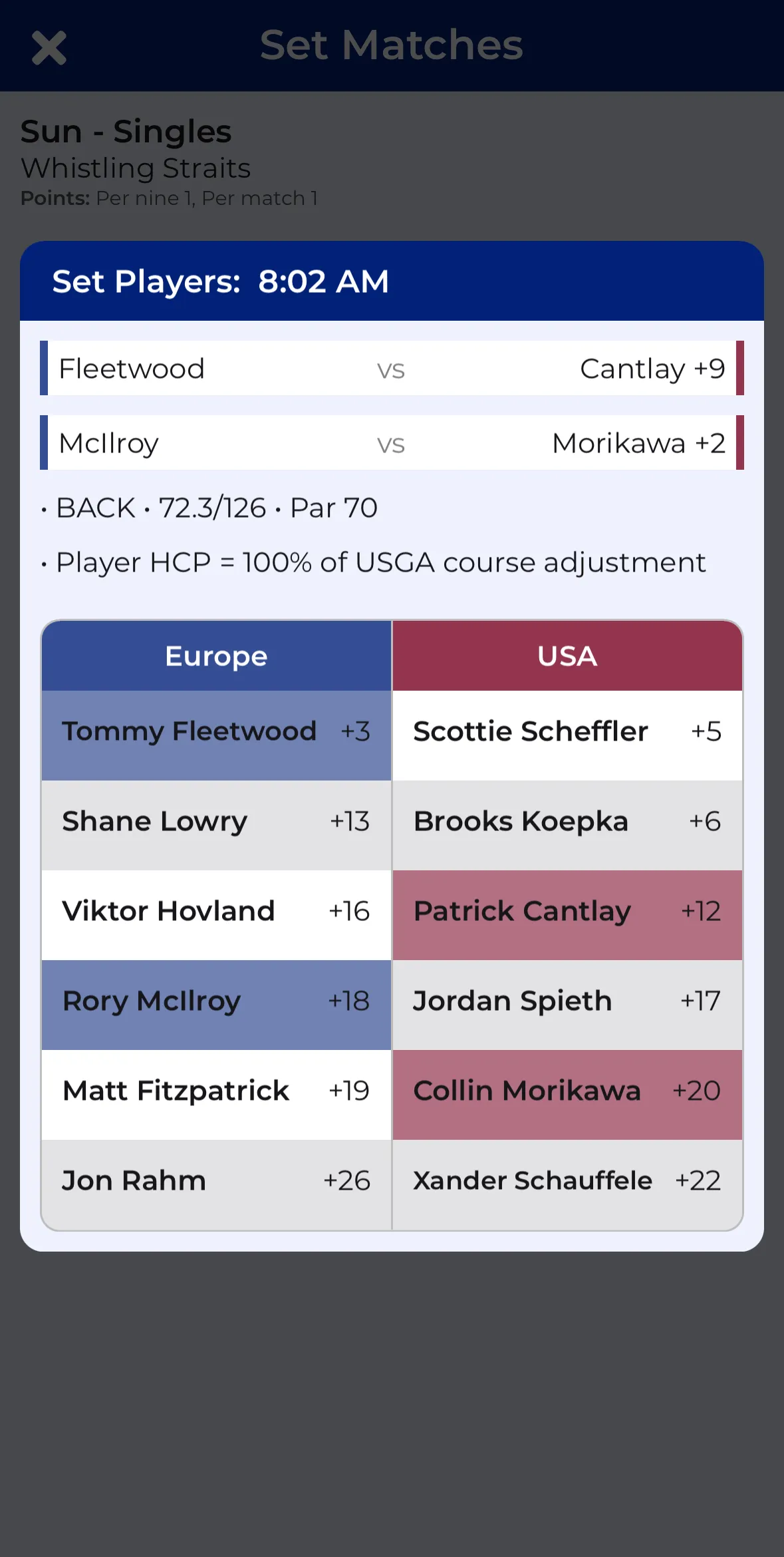
Match play is hole by hole. You win the hole, lose it, or tie it. The player (or team) who is up by more holes than remain wins the match. Handicap strokes are applied by giving the higher-handicap player extra strokes on specific holes.
Step 1: Calculate the Difference
In singles match play, subtract the lower Course Handicap from the higher one. The difference is how many strokes the higher-handicap player receives. The lower-handicap player plays off scratch (zero strokes).
Example: Singles Match Play
Player A: Course Handicap 8
Player B: Course Handicap 20
Difference: 20 − 8 = 12 strokes
Player A gets 0 strokes. Player B gets 12 strokes, applied on the 12 hardest holes on the course (ranked by the stroke index on the scorecard).
Step 2: Use the Stroke Index
Every course assigns a stroke index (also called handicap allocation) to each hole, ranked 1 through 18. Hole with stroke index 1 is the hardest, 18 is the easiest. Strokes are given starting from the hardest hole. In the example above, Player B would receive a stroke on the holes ranked 1 through 12.
On those holes, Player B gets to subtract one stroke from their gross score before comparing to Player A. If Player B makes a 5 and gets a stroke, the net score is 4. If Player A also makes a 4, the hole is halved.

Key rule
In match play, strokes are always based on the difference between players, not the full Course Handicap. This is what makes it a relative competition. You only need to beat the person across from you.
How to Apply Handicaps in Best Ball
Best ball (also called fourball) is a two-person team format. Both players play their own ball on every hole and the lower net score counts as the team score. Handicap allocation in best ball works a little differently than singles match play.
Step 1: Find the Lowest Course Handicap
Look at all four players in the match (two per team). The player with the lowest Course Handicap becomes the baseline. Their handicap is set to zero.
Step 2: Calculate Each Player's Strokes
For each of the other three players, subtract the lowest Course Handicap from theirs. The recommended allowance for best ball is 90% of the difference from the lowest player.
Example: Best Ball Match Play
Team 1
Team 2
Player A, CH: 6
Player C, CH: 10
Player B, CH: 18
Player D, CH: 22
Lowest Course Handicap: 6 (Player A). Apply 90% of the difference.
Player A: (6 − 6) × 0.9 = 0 strokes
Player B: (18 − 6) × 0.9 = 10.8 → 11 strokes
Player C: (10 − 6) × 0.9 = 3.6 → 4 strokes
Player D: (22 − 6) × 0.9 = 14.4 → 14 strokes
Each player gets their strokes on the corresponding hardest holes by stroke index, just like match play. On each hole, both teammates compare their net scores and the better one counts.
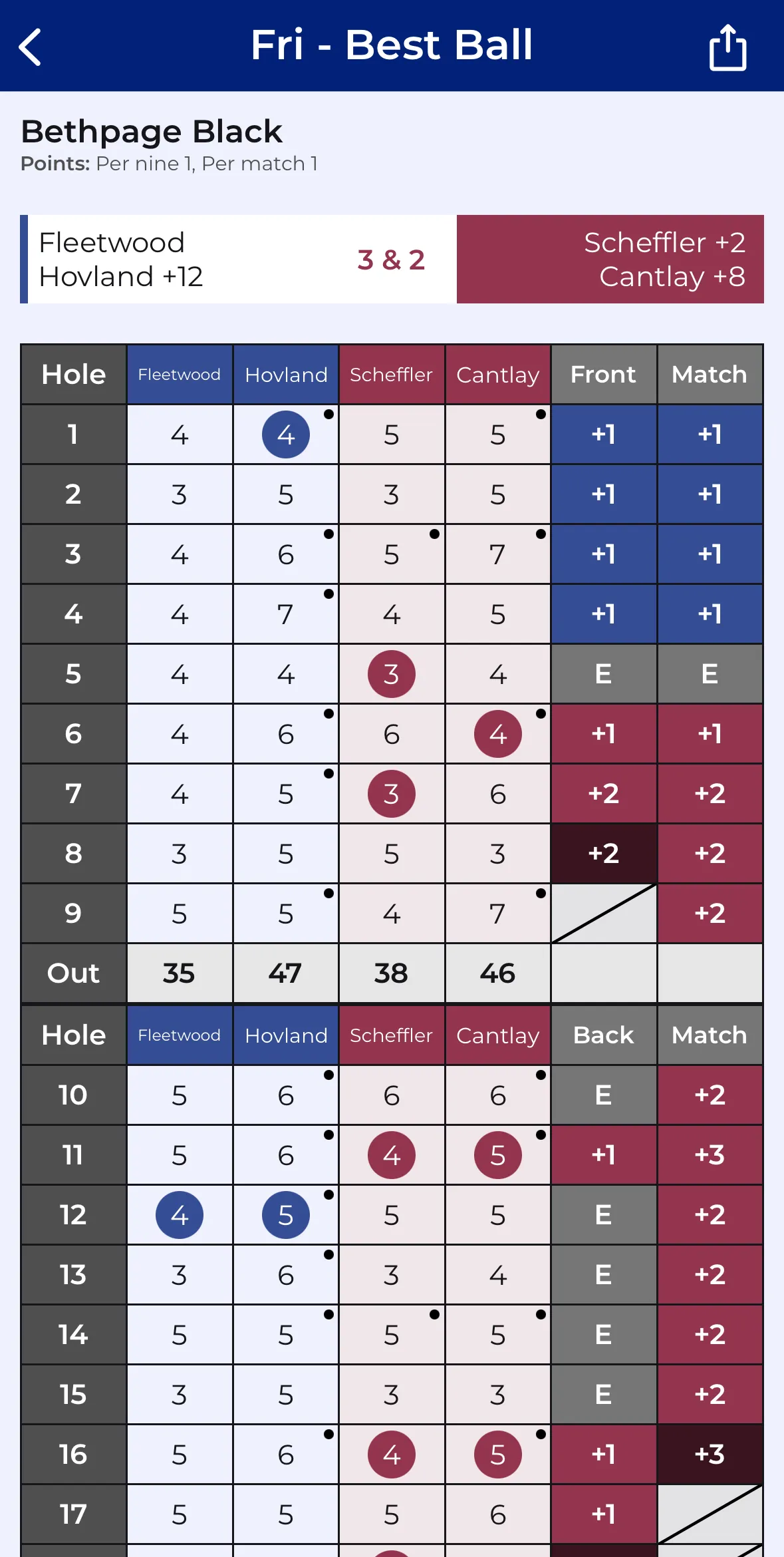
Why base it off the lowest player? Because match play is about relative performance. The lowest handicap player does not need any help, so everyone else gets strokes relative to them. This keeps the competition balanced without inflating the stroke count.
Handicap Allocation for Other Team Formats
Match play and best ball are the most common, but other team formats have their own handicap rules. Here is a quick reference.
| Format | Handicap Allocation | Notes |
|---|---|---|
| Singles Match Play | 100% of difference | Lower player plays off 0 |
| Best Ball | 90% of difference from lowest | All 4 players compared |
| Team Total | 100% of difference from lowest | All 4 players compared |
| Alternate Shot | 50% of combined team handicap, difference from lowest team | Add both players, halve it |
| Scramble | 35% low / 15% high (2-person) | Varies by number of players |
| Shamble | 75% of difference from lowest | All 4 players compared |
Alternate Shot (Foursomes)
In alternate shot, partners share one ball and take turns hitting. To calculate the team handicap, add both players' Course Handicaps together and take 50%. Then find the difference between the two team handicaps. The team with the higher combined handicap receives strokes on the hardest holes.
Example: Alternate Shot
Team 1: Player A (CH 8) + Player B (CH 14) = 22 ÷ 2 = 11
Team 2: Player C (CH 12) + Player D (CH 20) = 32 ÷ 2 = 16
Difference: 16 − 11 = 5 strokes to Team 2
Scramble
Scramble handicaps are the most reduced because the format already favors better players. For a two-person scramble, take 35% of the lower handicap and 15% of the higher handicap, then add them together. Use the scramble handicap calculator to get the team number instantly for 2, 3, or 4-player teams.
Common Handicap Mistakes in Team Events
Even experienced players get handicap math wrong. Here are the mistakes that come up most often.
- Using Handicap Index instead of Course Handicap. Your index is portable. Your course handicap is specific to the course and tees. Always convert before allocating strokes.
- Giving full handicap strokes in best ball. The recommended allowance is 90%, not 100%. Using full handicaps over-compensates higher-handicap players.
- Forgetting to use the stroke index. Strokes go on specific holes, not wherever a player wants them. The scorecard's stroke index determines which holes get strokes.
- Not recalculating when changing tees. If players play from different tees, each player needs a separate Course Handicap calculation using the slope and rating for their tees.
Skip the Math
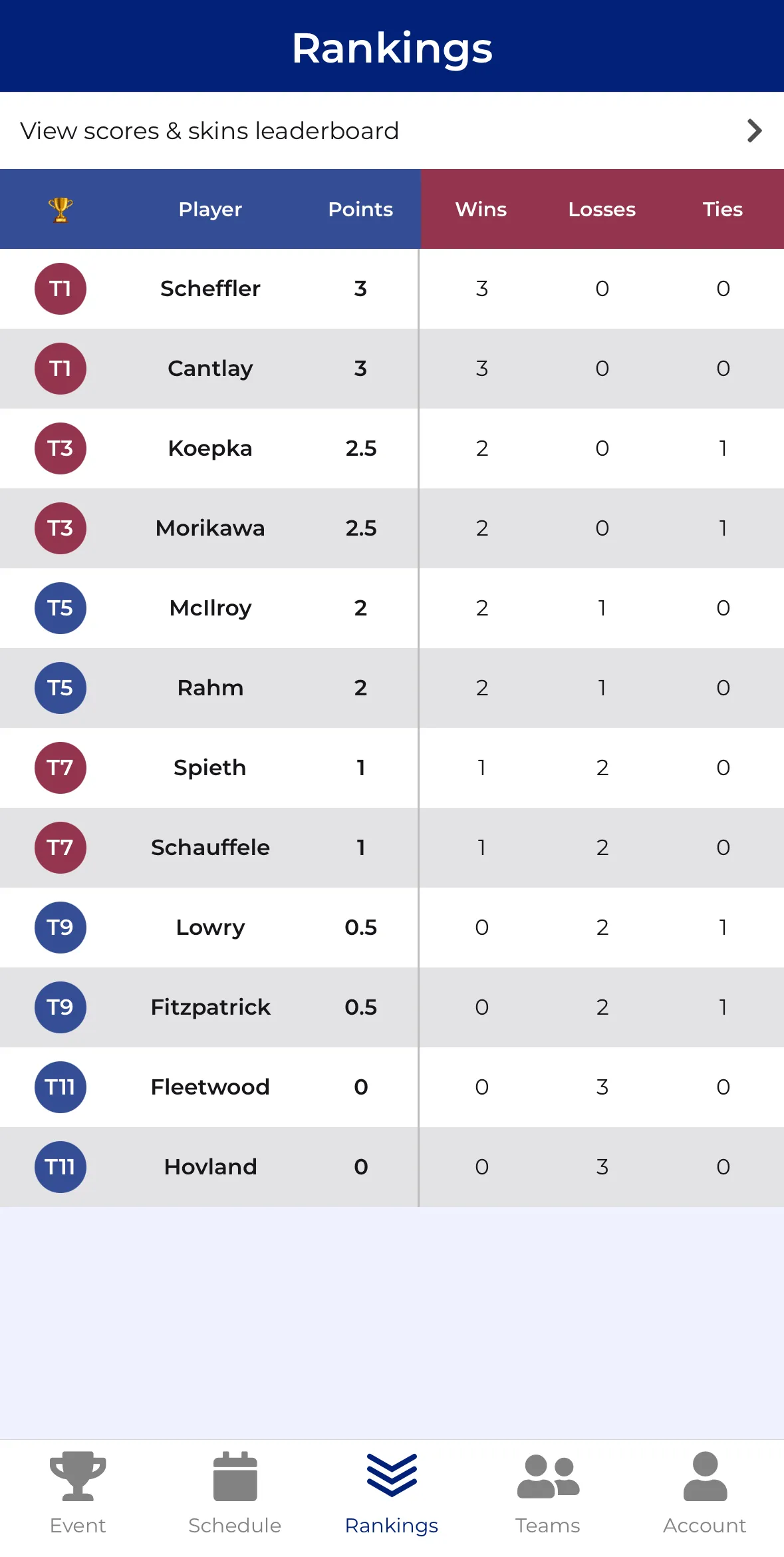
Calculating handicap strokes by hand is tedious. Get one number wrong and the whole match is off. CupTracker handles all of it automatically. Enter each player's handicap, pick your format, and the app allocates strokes to the correct holes for every match. No spreadsheets, no stroke index lookups, no arguments about who gets a stroke on 14.
It works for every team format, tracks live scores, and keeps a leaderboard your entire group can follow. Set up your Ryder Cup style event in minutes.
Loved by golfers. Read their stories